
The whole Ubiquiti ecosystem, installed by engineers who’ve run it for twenty years.
UniFi for the building — network, cameras, access, phones. UISP wireless for the distance between buildings. Most installers know one half of the line; we deploy both across Sarasota, Bradenton, Venice, and the rest of Southwest Florida, designed as one system with one company accountable for it.
One line, two jobs: the building, and the space between buildings.
Coverage and camera positions come first; the hardware list falls out of the design — not the other way around.
UniFi — the building platform
Enterprise switching, WiFi 7 access points, Protect cameras with AI, door access, and Talk VoIP — one console for everything inside the walls. It’s the deepest part of our practice, with its own page here.
UISP — point-to-point & long range
airMAX, airFiber, and LTU radios that carry a network between rooftops without trenching a foot of conduit — building-to-building links, guardhouse connections, and community backbones.
The foundation underneath
Structured cabling, fiber backbones, PoE budgets with headroom, and racks clean enough to photograph — the layer that decides whether everything above it stays up.
Ubiquiti hardware is only half the system. The other half is the install.
The gear is affordable and capable — which is why so much of it gets mounted badly. What decides year five is the engineering around it.
Design before hardware
Coverage mapping and channel planning inside the building; path profiling and Fresnel-zone clearance for every wireless link — on paper, before anything ships.
Surge protection on every outdoor run
Rooftop radios and exterior cameras are lightning's favorite path inside. Florida leads the country in strikes; every outdoor run we install gets ethernet surge protection.
Coastal-grade mounting
Salt air eats galvanized steel and hurricanes test every bracket. Coastal properties get marine-grade enclosures, stainless hardware, and wind-zone-rated mounts.
Documentation you actually receive
Labeled ports, a topology map, link budgets, and a credentials handoff — so the system outlives any one installer, including us.
This is what point-to-point looks like done right.
A private estate running five separate internet accounts across five buildings — consolidated into one engineered source and beamed property-wide by point-to-point wireless. The same discipline applies whether you’re linking two rooftops or a whole community.
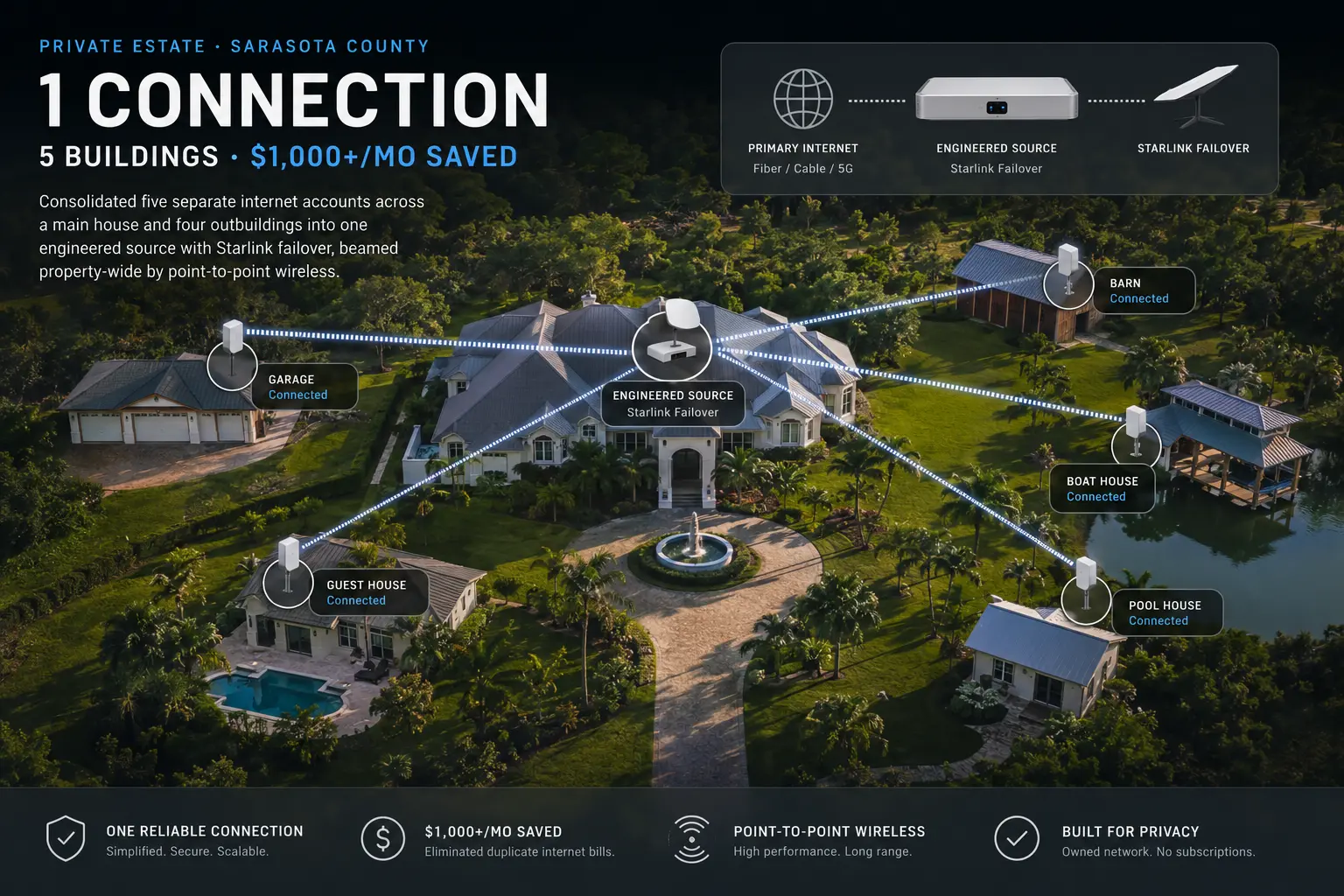
Consolidated five separate internet accounts across a main house and four outbuildings into one engineered source with Starlink failover, beamed property-wide by point-to-point wireless.
Questions Ubiquiti buyers actually ask.
UniFi is Ubiquiti's platform for buildings — network, cameras, door access, and phones in one console. UISP gear (airMAX, airFiber, LTU) is for distance: point-to-point and point-to-multipoint wireless that carries a network between buildings or across a property. Most of our projects use both, and we'll tell you plainly which parts of the line your property actually needs.
That's what point-to-point wireless is for. A pair of properly aligned radios can carry a gigabit-class link between rooftops — we've put five buildings on a single engineered internet source this way. Where fiber makes more sense, we'll say so; the answer falls out of the site survey, not a preference for one product.
Yes. We'll assess what's installed, keep what's specced right, and design around it — whether that's UniFi hardware someone else mounted or an airMAX link that needs realignment and surge protection. You won't be told to throw out working equipment.
Not to own your system. Ubiquiti hardware has no per-device licensing, and we don't sell monitoring contracts. If you'd rather Elite operate the network as a managed service, that's one optional monthly line item — your call, not a requirement.
It depends on the link distances, device counts, cable paths, and mounting conditions. The site assessment is free for properties in our service area and produces a line-item proposal, phased if the budget needs it — you keep the report either way.
Start with a site assessment.
We’ll walk the property, document what’s actually installed, and give you an honest read on what’s worth keeping — with numbers, not a pitch.