
IT support from the people who built the network, not the people guessing at it.
Most IT companies in Sarasota start at the desktop and stop at the wall jack. We start at the infrastructure — the network, the WiFi, the cameras, the cabling — and support everything running on top of it. When something breaks, we’re reading our own documentation instead of guessing at a system nobody wrote down.
“Have you called your internet provider?”
If you’ve heard that from your IT company, you already know the problem. It isn’t incompetence — it’s scope. The network was never theirs to begin with.
The infrastructure is the job
Slow WiFi, dropped calls, cameras that stop recording — these are almost never desktop problems. They’re design problems, and they get solved on the network side or not at all.
One number to call
When the network, phones, cameras, and door access all sit with one company, nobody gets to point at somebody else. That accountability is the entire product.
Documented before it breaks
Labeled ports, a topology map, a credentials handoff. The fix is fast because the homework was already done — not because someone worked late.
Infrastructure support, and the day-to-day underneath it.
Scope is set per property rather than sold as a fixed tier — a six-camera storefront and a multi-building business park don’t need the same agreement. These are the pieces it’s usually built from.
Network monitoring & maintenance
Switches, gateways, and access points watched for failures and capacity problems — with firmware and security updates applied on a schedule instead of after an outage.
WiFi performance & coverage
Channel planning, interference, dead zones, and the density problems that show up when a property fills up. Coverage is re-checked as the building changes, not assumed to be permanent.
User & day-to-day support
The ordinary requests: someone can’t connect, a device needs onboarding, a permission needs changing, a new hire needs setting up. Handled without a ticket disappearing into a queue.
Segmentation & access
VLANs that actually separate guest, staff, camera, and payment traffic; credentials reviewed when people join and when they leave. Security posture that follows the design, not a checkbox.
Cameras, access control & phones
The systems riding on the network stay covered too — recording health, retention, door credentials, and call quality, rather than being somebody else’s department.
Documentation kept current
Every change lands back in the record. The topology map is accurate the day you need it — including the day you decide to work with somebody else.
Three ways in. None of them start with a contract.
Every engagement opens the same way — a free site assessment that produces a written picture of what you actually have. You keep that document whether or not you hire us.
Assessment & audit
We document the network as we find it: what’s installed, what’s failing, what’s undersized, and what it would take to fix. No obligation attached, and no pressure to replace working equipment.
Project work
A defined build with a line-item proposal — a network rebuild, a camera system, a WiFi redesign. Phased options if the budget needs them, and no surprise change orders. Cable runs are performed by licensed subcontractors we work with directly.
Ongoing support
Monitoring, maintenance, and a standing relationship for the day-to-day. Scoped in writing before you commit, and structured so you can leave with your documentation intact.
What accountable looks like in practice.
A downtown Sarasota commercial property where tenant internet, cameras, and the network underneath all sit with one company — designed, installed, documented, and still supported.
Read the case study →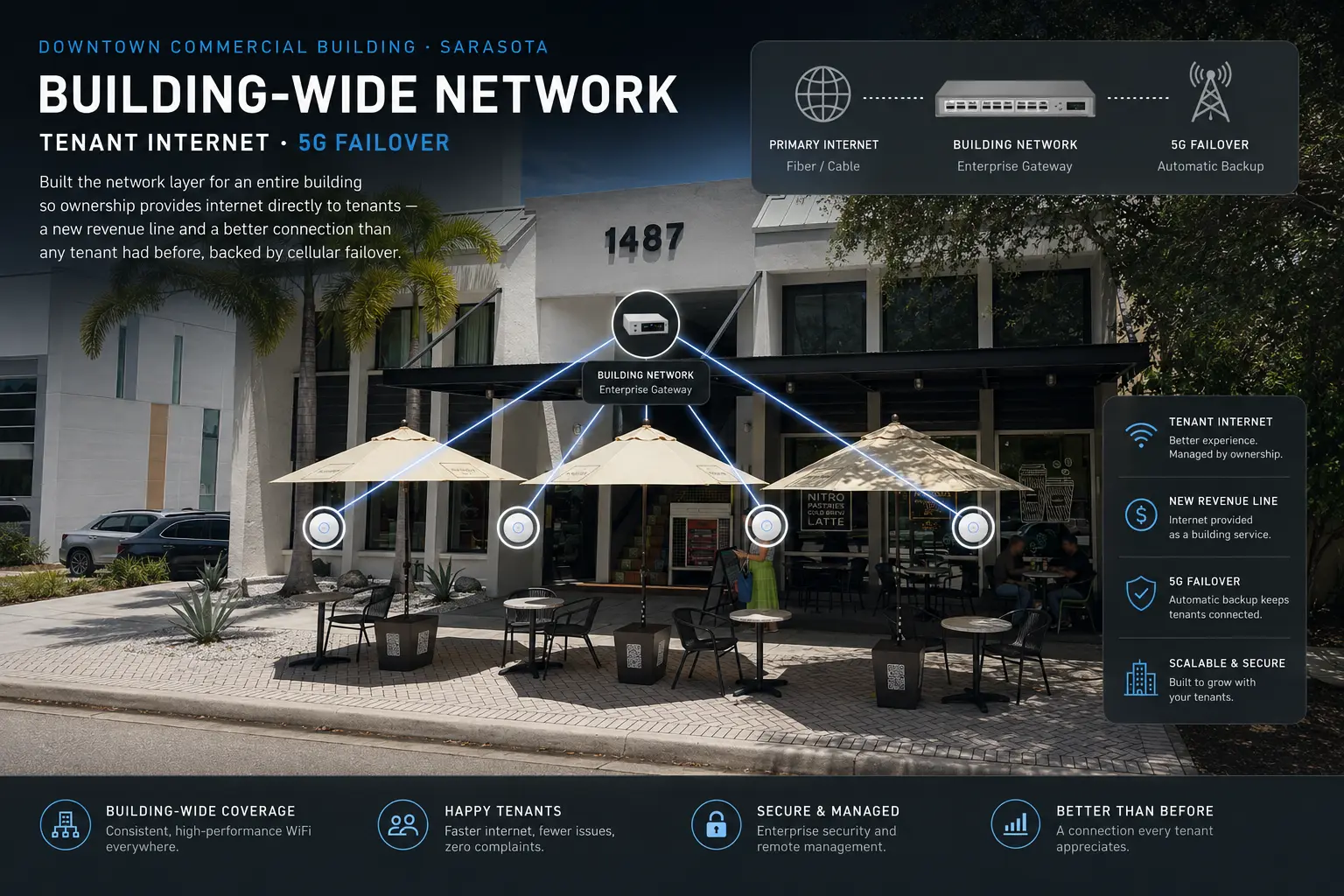
Before you call anyone.
Not necessarily. Plenty of our support work sits alongside an existing IT provider — they keep the laptops and software, we own the network, WiFi, cameras, and the infrastructure underneath. If that split is working, we don't argue with it. If you'd rather have one company accountable for all of it, we can do that too.
Most IT companies start at the desktop and treat the network as somebody else's problem — which is why the answer to a WiFi complaint is so often 'call your internet provider.' We come at it from the opposite end: we design and build the infrastructure first, so when something breaks we're reading our own documentation instead of guessing at a system we inherited.
Yes — takeover work is a steady part of our week. We start by documenting the system as we actually find it: labeled ports, a topology map, a credentials handoff. That audit is worth having even if you never sign a support agreement, and you keep it either way.
Both. Monitoring, configuration changes, and most troubleshooting happen remotely — that's faster for everyone. But we're a Southwest Florida company with local engineers, so when something needs hands on it, someone drives out. You aren't filing a ticket into a call center three time zones away.
It's scoped per property rather than sold as a fixed tier, because a six-camera storefront and a multi-building business park need different things. A typical agreement covers monitoring, firmware and security updates, configuration changes, troubleshooting, and a defined path for adds and moves. You get the scope in writing before you sign anything.
Sarasota, Manatee, and Charlotte counties — including Sarasota, Bradenton, Venice, Lakewood Ranch, North Port, Palmetto, Port Charlotte, Punta Gorda, and Englewood.
Start with the assessment.
A free site assessment, a written picture of what you have, and a straight answer about what it needs. Yours to keep either way.